
Hybrid Cloud Data Agility & AI Guardrails with Trace3 & NetApp
May 18, 2026
Are you struggling with data gravity, rising public cloud costs, or scaling AI workloads safely? In this Trace3 PressBox session, experts from Trace3 and NetApp discuss how a unified hybrid cloud data platform eliminates infrastructure silos, lowers risk with NIST-aligned ransomware recovery, and leverages smart cloning to accelerate data science without data bloat.
Check out these key sections:
00:00:00 - Introduction & Semiconductor Manufacturing Case Study
00:01:08 - Computer Vision & AI/ML at the Nano Level
00:01:53 - Navigating NAND Supply Chain Constraints & Pre-Buying Strategy
00:03:20 - Breaking Data Silos: File, Block, & Object on One Platform
00:04:35 - Fiber Channel Differentiators in Azure Local
00:05:45 - NIST Security Framework: Detect, Protect, & Near-Instant Recovery
00:07:15 - Initiating Risk Conversations with CISOs
00:08:45 - The NetApp AI Data Engine & Eliminating Data Bloat
00:09:40 - Secure Smart Clones & Redacting PII for Data Scientists
00:10:40 - Overcoming Data Gravity with FlexCache Multicloud Replication
00:11:45 - Cloud Repatriation: The Financial Realities of Hybrid Workloads
00:12:45 - Conclusion & Partnership Summary
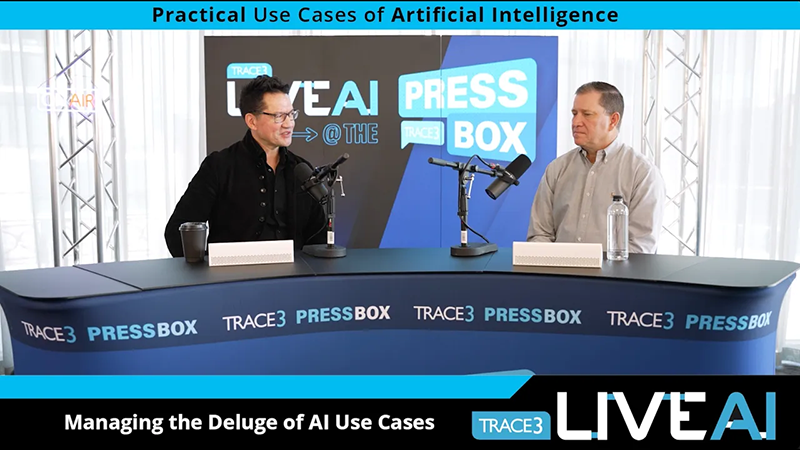
Trace3's Live AI | Episode 17 | Managing the Deluge of AI Use Cases
In Episode 17 of Trace3’s Live AI series, Trace3 CTO Tony Olzak and Kevin Geron, CIO of Farm Credit Mid-America, tackle one of the biggest hurdles facing enterprise leaders today: managing the overwhelming influx of AI use cases.
While generative and enterprise AI offer limitless potential, organizations must establish clear frameworks to prioritize, govern, and execute high-impact initiatives without getting bogged down by noise or technical debt.
In this episode, we cover:
How to filter and prioritize AI ideas based on business ROI and feasibility.
Establishing governance and risk controls without slowing down innovation.
Best practices for moving from experimentation to scalable enterprise deployment.
Real-world frameworks Trace3 uses to help organizations align AI strategy with business goals.
CHAPTERS:
0:00 - Introduction & The AI Influx Challenge
01:45 - Why Organizations Struggle with AI Prioritization
04:10 - Frameworks for Evaluating AI Business Impact & ROI
07:30 - Governance, Risk, and Compliance in Rapid AI Adoption
10:50 - Transitioning from Proof of Concept to Production
13:40 - Key Takeaways & Building an AI Roadmap
15:30 - Final Thoughts & Closing
Subscribe to the Trace3 channel for more insights on AI strategy, cloud architecture, cybersecurity, and data intelligence.
Learn more about how Trace3 accelerates enterprise AI: https://www.trace3.com/
Connect with Trace3 on LinkedIn: https://www.linkedin.com/company/trace3/posts/
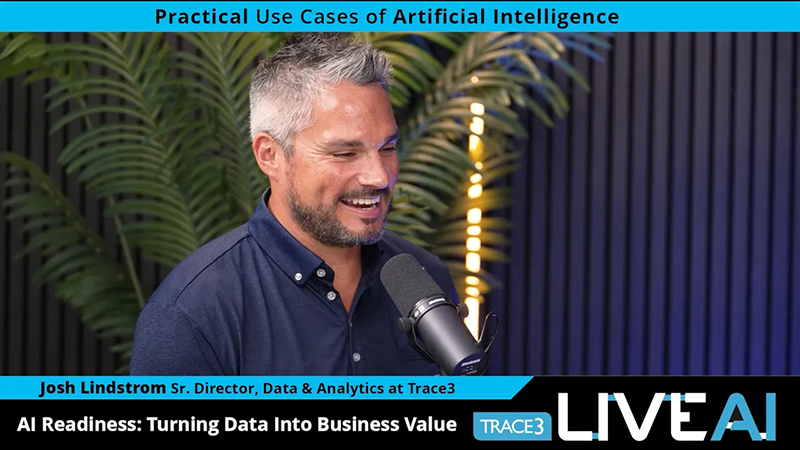
Trace3's LiveAI | Episode 16 | Turning Data into Business Value with NVIDIA and Everpure
In Episode 16 of LiveAI, host Josh Lindstrom (Senior Director of Data & Analytics at Trace3) sits down with industry leaders Jason Hardy (VP of Storage Technology at @NVIDIA ) and Kaycee Lai (VP of Enterprise AI at @everpure-data ) to discuss how enterprises can move past the proof-of-concept phase and turn dormant data into tangible business outcomes.
From the evolution of data storage to extreme co-design, the explosion of agentic workflows, and the reality of physical and edge AI, discover what it truly takes to fuel modern AI factories and achieve measurable ROI.
Key Topics & Timestamps:
00:00 – Welcome to LiveAI: Moving AI from Philosophy to Production
01:03 – Guest Introductions: Jason Hardy (NVIDIA) & Kaycee Lai (Everpure)
02:07 – The Power of Co-Design: Building the Modern AI Factory
03:52 – Beyond Speeds & Feeds: Activating Stored Data for AI
06:00 – Fueling the AI Factory: Data Prep, Libraries & Blueprints
08:30 – Data Resilience, Readiness & Overcoming the Governance Hurdle
14:41 – Moving Out of PoC: How Enterprises Uncover & Prioritize AI Use Cases
18:05 – Aligning AI Blueprints to Industry Verticals & Clear ROI
27:10 – Model Strategy: Open Weights, Frontier Models & Tokenomics
30:38 – What’s Next in AI: Agent Swarms, Physical AI & Edge Inferencing
37:00 – Advice for the Next Generation: Creativity as the Superpower
42:50 – Closing Thoughts & Next Steps
Key Takeaways:
Data Is the Fuel: High-performance infrastructure means nothing if your data isn't prepared, resilient, and accessible to AI agents.
Use-Case Driven ROI: Successful enterprises don't just buy hardware—they align specific business pain points to tailored AI blueprints and workflows.
The Agentic Shift: Future enterprise productivity will be driven by swarms of 24/7 autonomous agents handling both structured and unstructured data across the network.

AI in Customer Experience: Guardrails, Automation & the Human Element
AI can transform customer experience—but without the right guardrails, it can also create new friction.
In this Trace3 PressBox conversation, Trace3's Asher Lohman and Michael Burr from @NICE-Systems discuss how organizations can use AI to augment contact-center teams, protect the human element, and connect automation to measurable business outcomes.
Topics include:
How CX is evolving from individual interactions to end-to-end customer relationships
Where organizations should begin with AI adoption
How to identify low-risk, high-value use cases
Why business problems should come before technology decisions
The role of human oversight, data access controls, and AI guardrails
How agentic and deterministic workflows can work togetherA CX transformation involving 7,700 agents
Chapters:
00:00 - Introduction: The Balancing Act of AI in CX
00:56 - Trace3 & NICE Partnership & Customer Journey Evolution
02:24 - NICE’s Cognigy Acquisition & CXAI Strategy
03:24 - Navigating People, Processes, and Tech in AI Adoption
05:07 - Identifying Real CX Pain Points vs. Symptoms
07:05 - Augmentation First: Preserving the Human Element
08:15 - Guardrails, Governance, and AI Risk Management
10:12 - Agentic Flows vs. Deterministic Workflows in Cognigy
12:13 - Case Study: Transforming a 7,700-Agent Financial Institution
14:00 - Key Takeaways & Closing Thoughts